Sicilian social stagnation
The LeopardSicilian social stagnation in The Leopard is more than resistance to a particular political change: it is the persistent condition that makes change appear unable to transform the island’s underlying life. Across the evidence, political movements, national ideals, and even new rulers meet a landscape and society figured as inert. The novel’s account of unification consequently carries a double meaning: political change occurs, yet the Sicilian condition seems to outlast it.
A condition beyond a single moment
The phrase “Sicily is Sicily – 1860, earlier, forever” compresses this persistence into a formula that refuses to confine the island’s condition to the year of political upheaval. The sequence connects 1860 with both an earlier past and an indefinite future. Stagnation is therefore presented not as a temporary pause before progress, but as a recurring structure through which new events are absorbed without producing a decisive transformation.
The critical account of the novel describes its attention as fixed on a “mineral kingdom,” populated by animate and inanimate fossils through which Lampedusa identifies the Sicilian condition. The image makes arrested life central to the novel’s view of society: the living world is not separate from the inert one, but appears caught in a shared state of persistence. The account also notes that positive comments on Unification survive chiefly within the novel’s fictional structure and seldom interrupt this sustained description. Political change is present, but it does not become the governing assurance that history is advancing toward renewal.
The sun and the Prince’s political insight
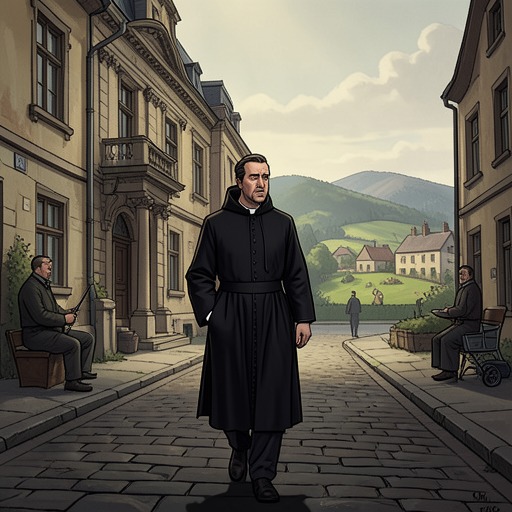
On the morning of 13 May, after political discoveries have calmed him, Don Fabrizio Corbera, Prince of Salina, looks out from a small tower. The view extends over countryside, sea, mountains, and Palermo. What had seemed threatening during the night now appears quiet, and even the foreign warships in the harbour do not disturb the scene’s composure. The passage shifts from the immediate political crisis to a wider image of a society held still beneath the sun.
The sun is presented as Sicily’s true ruler: its force seems to annul individual will and keep everything in “servile immobility.” This image gives stagnation a physical and environmental scale, but its function is also political. The Prince understands that a change of sovereign cannot by itself undo the habits and conditions that hold the island in place. He doubts that even repeated rulers bearing the name Victor Emmanuel could permanently alter the force that governs Sicilian life. The point is not that political events are unreal, but that their effects encounter a deeper resistance than a change of government can overcome.
The scene also develops through contrast. The Prince’s calm follows political discoveries, yet the landscape does not register the promise of a new political order as a corresponding social awakening. The warships remain visible; Palermo lies quiet around its monasteries; the sun continues its rule. The composition places political possibility inside a world whose prevailing impression is continuity. Stagnation is thus conveyed not only as an idea voiced by the Prince, but as the relation between historical events and a setting that seems to absorb rather than answer them.
Unification and the failure of concord
The song La bella Gigougìn supplies a concrete instance of the distance between national rhetoric and Sicilian experience. In the account cited by the critical discussion, the Garibaldini sing it at the capture of Milazzo. In The Leopard, mainlanders sing the song during the campaign for the plebiscite at Donnafugata. Though described elsewhere as a hymn to national concord, its recurrence in the novel has a contrary effect: it underscores how little the Sicilians and their invaders have to say to one another.
The song’s repetition therefore does not establish a shared national feeling. It places the language of unity beside a scene of political campaigning in which the groups remain divided. A national symbol travels into a new setting, but its meaning changes: instead of reconciling the island with those arriving from the mainland, it makes their lack of communication more legible. The episode gives stagnation a social dimension. The obstacle is not simply that political events have yet to happen; even when unification is being enacted and celebrated, the participants do not thereby become a community with a common understanding.
Political ideology and historical form
Lampedusa’s treatment distinguishes approval of the ideology of the Risorgimento from distrust of its rhetoric. The critical account characterizes him as approving the ideology and admiring revolutions that had proved effective, while remaining alert to the failures of taste that ideological rhetoric can bring. Its comparison with another novel of civilizational decline emphasizes that Lampedusa interrupts description when it risks becoming artificial. In this view, caution about rhetoric is part of the novel’s realism: the narrative does not allow national feeling to smooth away the contradictions of political change.
That restraint shapes how the novel presents progress. The critical account observes that the denial of transcendence, even at the level of ideology, is disagreeable to anyone who believes they have something to contribute to Progress. The novel’s attention to Sicilian immobility can thus frustrate a progressive reading without simply erasing the political upheaval. Unification remains within the fictional structure, but the recurring image of an enduring, fossil-like world limits its power to promise a transformed society. The tension between political event and social persistence is itself part of the subject.
Significance
Sicilian social stagnation links the political, social, and descriptive dimensions of The Leopard. The Prince’s view from the tower renders immobility as a governing condition; the song at Donnafugata turns the promise of national concord into evidence of estrangement; and the novel’s distrust of triumphant rhetoric keeps political change from becoming a simple story of progress. Together these elements give historical upheaval real presence while withholding the assurance that it can remake the life beneath it. The island’s continuity is not an absence of events, but the force that shapes what those events can mean.